

27 Apr How We’re Finishing First Grade Strong: Let’s Chat About Our Resources & Schedule
This post contains affiliate links. I may earn a small commission at no extra cost to you.
Here’s something that will surprise absolutely no homeschooling family…
Spring is hard.
Not hard like we-want-to-quit hard. More like… the new curriculum smell has worn off, the “back to school” excitement has been gone for a while, and somewhere around February you start to feel the very specific kind of bored that only comes from doing the same kind of thing every day in the same house with the same two small humans who keep asking if it’s lunchtime yet.
And then, at least for me, something shifts. It seems to happen every year around March. The weather changes (even here in South Florida, where “spring” basically means “it’s about to get aggressively hot”). The days get longer. And I get this second wind that makes me want to plan up a storm, finish strong and show up for the last stretch like I’m crossing a finish line.
This is very on-brand for me. I am, how should I put this… a passionate beginner. I will start things with the energy of someone who has just discovered a new hobby and can’t wait to learn anything and everything about it. Finishing things? Historically, that’s been a different story.
I am, how should I put this… a passionate beginner. Finishing things? Historically, that’s been a different story.
But this year, we are going to try and do it differently. I want to share exactly how, because I think a lot of you are in this same exact spot right now.
First, Let Me Explain Our Year-Round Schedule
We don’t do a traditional September-to-June school year. We homeschool year-round on a loose, flexible schedule, which can either sound like “we do school ALL THE TIME” or “we do school whenever we feel like it” (the latter is not totally wrong) but it is actually an intentional decision.
Here’s what it actually looks like for us:
We take breaks when it makes sense for our family: holidays, off-peak travel, when someone is sick, when the weather is too beautiful to be inside, when we need to reset. But we also school in July. And in December. And occasionally at 4pm on a Saturday because someone (usually me) got obsessed with a topic and we just kept going.
The benefit of this approach is that there’s no pressure cooker feeling. No “we have to get through X chapters before June.” The year has a rhythm instead of a deadline. And for my ADHD brain, rhythms work way better than deadlines.
For my ADHD brain, rhythms work way better than deadlines.
The real downside is that it can be easy to let things drift. When there’s no hard stop date, “we’ll get back to that next week” can quietly become “wait, did we ever finish that unit?” (Answer: sometimes no. Totally fine. Moving on. Let’s not mention it.)
So here’s where we are right now: my twins will turn 8 at the end of May, we started first grade last summer in July, and we’re planning to shift into second grade this July. That gives us about 15 weeks from late March to close out first grade and head into summer mode before our July restart.
Quick note about starting school in July. Listen… I LOVE traditional back-to-school season, the new school supplies alone, right? But the routine-less-ness (I don’t know, I might have just made up that word, just go with it) of summer does not work for us. At all. Shifting that start date from September to July really put us in a good place. We get that “back-to-school” excitement exactly when we need it… smack dab in the middle of summer when all three of us are craving some kind of routine.
Fifteen weeks feels like a lot. It’s not. But it’s enough, if you have a plan.
The “Am I Doing Enough?” Spiral
I KNOW I’m not the only one.
There is a specific flavor of mom guilt that exists exclusively in the homeschool space and it sounds like: “Are they behind? Are they missing something? What if I’ve just been doing this wrong the whole time? Mrs. Whoever’s kids at the school down the street are probably learning cursive and multiplication and… wait, do they do multiplication in first grade now?”
I have been in this spiral. I live in this spiral, we’re basically besties. And every time I step back and actually look at what my boys know, what they can do, what they get excited about, I am genuinely amazed.
Here’s what I’ve come to understand: the fact that you’re asking “am I doing enough” almost certainly means you are doing enough. The parents who maybe aren’t doing enough aren’t lying awake googling first-grade reading benchmarks after midnight.
But that doesn’t make the feeling go away, does it? So instead of just telling you “you’re doing great, mama!” (even though you are), let me show you what our actual first grade year has looked like: resources, wins, messy moments and all.
Our First Grade Non-Negotiables
Every family’s homeschool looks different, and that’s the whole point, isn’t it? But in our house, two things are non-negotiable every single week, no matter what unit we’re in or how scattered life feels:
📖 Hooked on Phonics — Daily, every school day, rain or shine.
My boys had a speech delay and spoke only their secret twin language for a while before they decided to give English a try. Looking back, I cannot believe how far they’ve come. Reading is the foundation of everything in our homeschool, and HOP has been the most consistent, drama-free part of our entire school year. We try to do it first thing every morning. It takes about 20 minutes. It works.
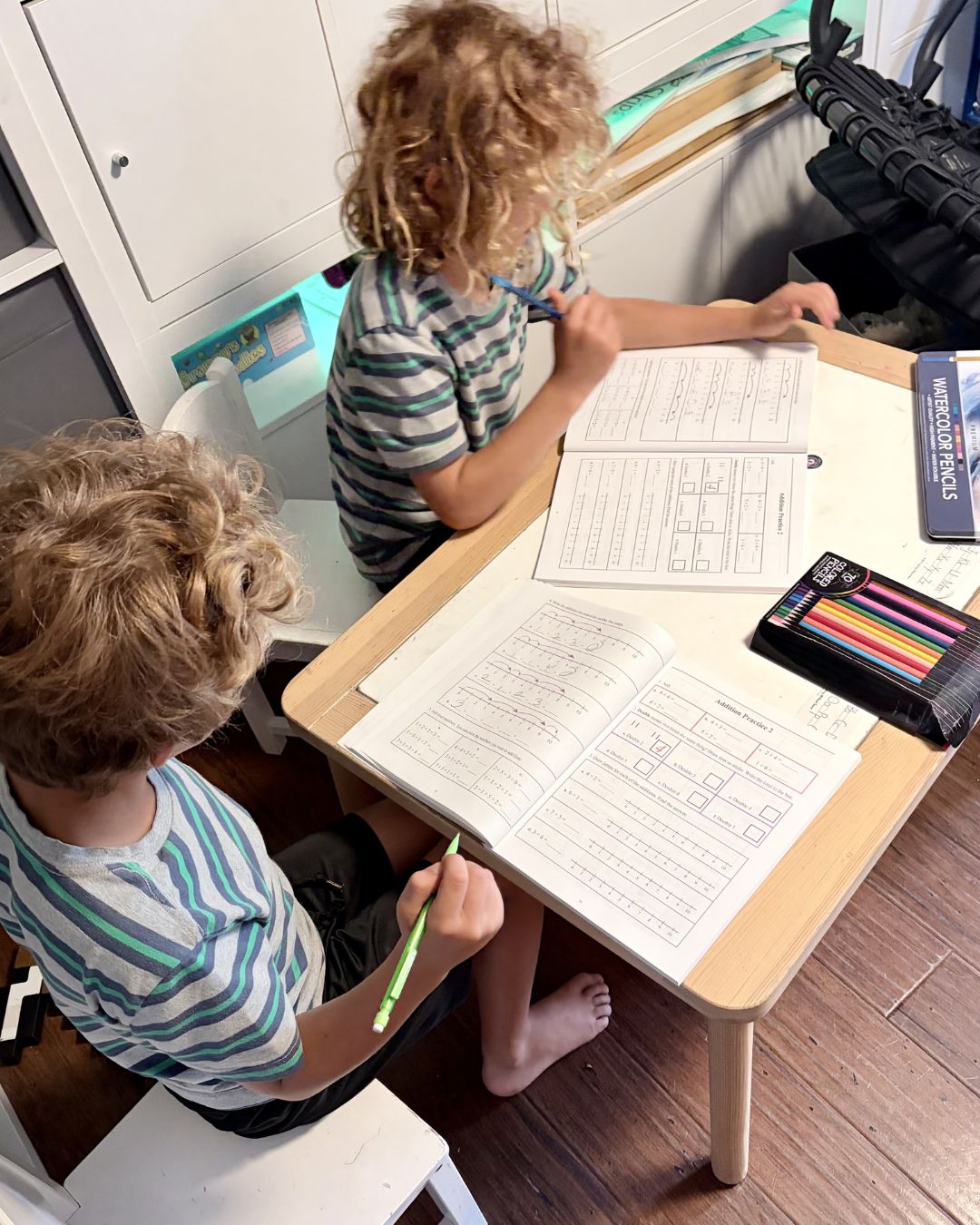
➕ Math Mammoth — Most days, supplemented with things that make it fun.
Math Mammoth is our core math curriculum. It’s thorough, it’s affordable, it’s not flashy, but it works. We layer in Beast Academy (because monsters + math = obviously! Just FYI, I do find this workbook leans more logic than core math), and Comic Book Math from The Thinking Tree when we just need to switch it up with something completely different.
For our low-pressure family game days we rotate between a few favorites that sneak in real math without anyone noticing. If you want the full breakdown of what we play and why, I did a whole post on our favorite educational board games check it out!
Side note: my only complaint about the Math Mammoth curriculum is that one of the boys’ workbooks came in full color and the other is in black and white. So, that was a little dramatic for a while. 😂
The key for us is that Math Mammoth never gets dropped. Everything else is a supplement. Having one anchor makes it easy to stay consistent even when life gets messy.
The Rest of Our First Grade Finish Plan
Outside our two non-negotiables, here’s how we’re rounding out the year:
⚡ Harry Potter
We just finished reading the entire Harry Potter series together. All seven books. My seven-year-olds. I am not taking full credit for this, but I am absolutely taking some credit for this.
For the last 15 weeks of first grade, we’re working through all the HP supplement books: Fantastic Beasts, Tales of Beedle the Bard, the Wizarding Almanac, the Character Vault, and more. Each one becomes a 2–3 week project-based unit. Character studies, beast encyclopedias, map-making, fairy tale analysis. It covers reading comprehension, writing, critical thinking, art, and geography, and it’s all wrapped in a world they are deeply, enthusiastically invested in.
Is it a “real” curriculum? Nope. Does it matter? Also nope.
🔬 Noeo Science Biology 1
We just got our Noeo Science Biology 1 kit and lab manual in the mail and I am irrationally excited about it. Noeo is structured around real books, narration, and hands-on experiments, which is exactly how my boys learn best and, not coincidentally, how I teach best. Biology 1 covers living vs. nonliving things, plants, animals, ecosystems, and habitats. All 15 lessons fit perfectly into our 15-week window.
We’re pairing this with our Florida nature study, the Handbook of Nature Study, the Audubon Field Guide to Florida, and honestly just going outside, which is free and deeply underrated as a curriculum.
✏️ Writing — WriteShop Primary + Easy Grammar + Spelling
Writing is the area where I’ve done the most tinkering this year, and I think we’ve finally landed on a combination that actually works for us.
WriteShop Primary is the foundation. If you haven’t heard of it, it’s a writing curriculum specifically designed for young writers — ages 5–8 — and it’s incredibly gentle and structured without being rigid. Each unit builds on a simple writing concept (describing words, action words, sequencing) and guides kids through the process step by step. For my boys, who would rather draw a picture than write a sentence, it’s been the missing piece. It doesn’t overwhelm them. It builds confidence first and skill second, which is exactly the right order at this age.
We layer in Easy Grammar Grade 1 twice a week (each lesson is literally one page… painless), Fun-Schooling Spelling Journal for spelling, and Handwriting Without Tears for fine motor practice. Nothing fancy. Consistent and done.
🌍 World Studies & Geography
This is where we get to be the most creative. We pull from Children Just Like Me, Global Feast, the Amazing World Atlas, and the Magic Tree House series depending on what connects to what we’re currently studying. Geography shows up organically, and when it’s connected to a story or a food or a real kid’s life, it actually sticks.
🎨 Art
A Year in Art for artist studies, Art Workshops for Children for technique practice, and The Kids’ Multicultural Art Book when we want to tie art to the cultures we’re studying. We also love following watercolor tutorials online… and I say “we” because I have my own watercolor sketchbook and follow along too. “Structured” art is probably once a week in our house, usually tied to whatever unit we’re in. But take one look at our dining table covered in paint that won’t come off and the art cart permanently parked in the living room, and you’ll know art is really an all-day, every-day opportunity around here.
All the Resources, In One Place
Here’s everything we’re using to finish out first grade — in case you want to look any of these up:
📖 Hooked on Phonics Level 4 — Our daily phonics anchor. Simple, structured, works.
➕ Math Mammoth — Our math core. Thorough, affordable, consistent.
🧩 Beast Academy — Enrichment math with monsters. The boys are kind of obsessed.
✍️ WriteShop Primary — Gentle, structured writing for young writers. The missing piece for us.
📝 Easy Grammar Grade 1 — One page per lesson. Literally painless.
📓 Fun-Schooling Spelling Journal — Spelling that doesn’t feel like drilling.
🔬 Noeo Science Biology 1 — Book-based, hands-on science. Perfect for curious kids.
📗 Handbook of Nature Study — Paired with outdoor time and our FL nature walks.
⚡ HP Character Vault — Deep dive into characters in the Harry Potter universe.
🐉 Fantastic Beasts (Rowling) — Beast classification + encyclopedia project.
📜 Tales of Beedle the Bard — Fairy tale structure + shadow puppet retelling.
🌍 Amazing World Atlas (DK) — Geography tie-ins throughout the whole unit.
🎨 A Year in Art — Artist studies.
🌿 Nature Anatomy (Rothman) — Beautiful visual supplement for science.
Why Spring Is Actually the Best Time to Restart
Here’s maybe an unpopular opinion about year-round homeschooling: the spring push is actually easier than the back-to-school push, because your kids already know how to do school with you.
When you’re starting a new school year, you’re negotiating everything. How long do we sit? Who gets the green pencil? Why do we have to do math before lunch? By March, those battles are mostly won (or lost and abandoned completely, no judgment here!). Your kids know the rhythm. They know what to expect and what you expect. They know that if they do their phonics first, they get to do the fun HP stuff after.
The second wind is real. Embrace it!
For us, this spring stretch is about finishing what we started (or, if I’m being completely honest, rolling it gracefully into second grade) not perfectly, not Instagram-worthily, but genuinely. We started first grade with two curious boys who were just learning to read. We’re ending it with two kids who devoured seven Harry Potter books, built crystal experiments in our kitchen, and can tell you the capital of Scotland because they wanted to know where Hogwarts would be.
That’s a first grade year I’m proud of. Mess and all.
That’s a first grade year I’m proud of. Mess and all.
Your Turn
If you’re in the spring stretch right now and feeling the familiar mix of second-wind excitement and “wait, how is it already March” mild panic, you’re in good company.
You don’t have to overhaul everything. You don’t have to buy new curriculum (unless you want to, of course, what’s better than new curriculum?). You don’t have to become a different kind of homeschool mom than you already are.
You just have to keep showing up. Messy, flexible, curious, and present. That’s it. That’s always been it.
Tell me in the comments: what does your spring stretch look like? Are you a passionate beginner too, or have you cracked the code on follow-through? (If you have, please share your secrets immediately.)
Learning is messy. Embrace it. 🖤
No Comments